

On the eastern edge of Kochi’s rapidly expanding metropolitan sprawl, Kizhakkambalam is one of those places that easily slips past the radar of most travelers heading to Kerala’s better-known backwaters and hill stations. Yet this unassuming village in Ernakulam district has, over the last decade, become one of the most talked-about local self-government units in the entire country — not for a temple festival or a filming location, but for an unusual experiment in grassroots governance that blurred the line between corporate social responsibility and electoral politics.
Located in the Kunnathunad taluk of Ernakulam district, Kizhakkambalam sits roughly 22 kilometres east of the district headquarters at Kakkanad and about 15 kilometres from the industrial town of Perumbavoor. Its proximity to Kochi — Kerala’s commercial capital — means that while the village retains a distinctly rural character, with paddy fields, coconut groves, and the Kadambrayar (Chithrappuzha) river flowing through it, it is also firmly plugged into the economic pulse of one of South India’s fastest-growing urban regions. This dual identity, half village and half satellite town, is part of what makes Kizhakkambalam such an interesting case study.
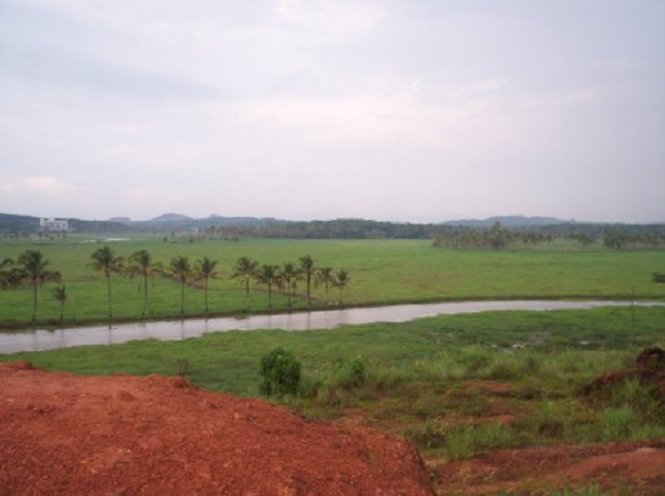
Table of Contents
A Village Built Around a Factory
Kizhakkambalam’s modern story is inseparable from the history of Kitex Garments, part of the Anna-Kitex Group, which has been headquartered in the village since 1968. What began as a modest textile venture grew into a major garment exporter, eventually being recognised among Forbes Asia’s list of top companies under a billion dollars. The company’s growth turned Kizhakkambalam from a sleepy agrarian settlement into a hub of industrial employment, drawing workers not just from the immediate vicinity but from across the district.
It was this corporate presence that set the stage for one of the more unusual political developments in recent Kerala history. In 2013, the Anna-Kitex Group launched a charitable initiative called Twenty20, named for its founding ambition of transforming Kizhakkambalam into a “model village” by the year 2020. Twenty20 began modestly — building drinking-water tanks, running subsidised food outlets, and operating a free ambulance service — all funded through the company’s CSR budget. But by 2015, the organisation had evolved from a welfare body into a full-fledged electoral force, fielding candidates in the local panchayat elections.
The results stunned Kerala’s political establishment. In a state famous for its deep-rooted, highly organised leftist and unionist politics, Twenty20 swept 17 of the 19 seats in the Kizhakkambalam grama panchayat, brushing aside the traditional Congress- and CPI(M)-led fronts. It was a rare instance anywhere in India of a corporate-backed outfit winning a direct mandate to run local government, and it triggered years of debate about whether the model represented genuine grassroots development or a corporation quietly consolidating influence over the very village where its factories operate.
Whatever the political reading, the tangible changes were hard to ignore. Under Twenty20’s stewardship, Kizhakkambalam saw new roads, housing projects for economically weaker families, upgraded drinking-water infrastructure, and a subsidised food-security market that let residents buy staples like rice, sugar, and cooking oil at below-market rates using a village-issued consumer card. The panchayat, unusually for a rural local body in India, began posting budget surpluses instead of running deficits — a distinction it has continued to claim in more recent years, with officials pointing to substantial surplus funds in recent financial years driven by better collection of licence fees, professional taxes, and building-permit revenues alongside continued private support. Twenty20 has since expanded its footprint into neighbouring panchayats and, over a decade after its improbable debut, entered into a formal political alliance with a national party ahead of Kerala’s 2026 assembly elections — a sign of how far the once purely local outfit has travelled from its CSR origins.
Life, Land, and Livelihood
Away from the politics, Kizhakkambalam remains, at its core, a Malayalam-speaking agrarian community. The village covers a geographical area of roughly 2,281 hectares, a large share of which is still under cultivation, growing paddy and other traditional crops alongside coconut palms that line its backroads. The Kadambrayar river and its tributaries thread through the village, historically used for irrigation and still valued as a scenic, if occasionally polluted, natural feature of the local landscape.
Housing in the village is dense but low-rise, organised around a network of wards administered by the grama panchayat, Kizhakkambalam’s basic unit of local self-government under India’s Panchayati Raj system. The panchayat itself falls within the Vazhakkulam block panchayat and the Kunnathunad assembly and parliamentary constituency, connecting the village to the wider administrative machinery of Ernakulam district and the Kerala state government.
Beyond Kitex, the local economy runs on a mix of small trade, services catering to Kochi commuters, and agriculture, though the presence of a major employer within village limits has meaningfully shaped local demographics and household incomes compared to more remote parts of rural Kerala. Educational infrastructure in and around the village includes a mix of government and private schools, reflecting the generally high baseline of literacy and schooling access that Kerala is known for nationwide.
Why Kizhakkambalam Matters Beyond Its Size
For a village of its size, Kizhakkambalam has generated an outsized amount of academic and journalistic interest. Political scientists have studied it as a case of corporate paternalism intersecting with democratic institutions; development economists have pointed to it as evidence that concentrated private investment in public goods can visibly transform a small locality’s infrastructure in a short span of years; and critics have used it as a cautionary example of how easily a company’s commercial interests can become entangled with the very local government meant to regulate it, including past friction over pollution allegations tied to Kitex’s manufacturing operations.
Whatever position one takes in that debate, Kizhakkambalam offers a genuinely distinctive lens into how rural governance, corporate power, and community welfare can intersect in modern India. It’s not a destination most travel guides will point you toward, and it doesn’t have a marquee tourist attraction to its name. But as a live case study in how a single company’s ambitions reshaped an entire village’s roads, water supply, food security, and even its ballot box, Kizhakkambalam has earned a place in conversations about Kerala’s future that far exceeds its modest population and quiet, palm-lined streets.
Quick Facts About Kizhakkambalam
- State / District / Taluk: Kerala / Ernakulam / Kunnathunad
- Type: Village and Gram Panchayat
- Population (2011 Census): 23,186
- Male population: 11,375
- Female population: 11,811
- Sex ratio: 1,038 females per 1,000 males (below the Kerala state average of 1,084)
- Child sex ratio (0–6 years): 1,014 (higher than Kerala’s average of 964)
- Literacy rate: 94.74% overall (Male: 96.70% | Female: 92.84%), compared to Kerala’s state average of 94%
- Number of households: Approximately 5,551
- Average household size: About 4 persons per house
- Total geographical area: 2,281 hectares
- Population density: Roughly 1,016 persons per sq. km
- Pincode: 683562
- Local language: Malayalam
- Administration: Governed by an elected Gram Panchayat (Sarpanch as head), under Vazhakkulam Block Panchayat
- Assembly/Parliamentary constituency: Kunnathunad
- Distance from Kochi/Kakkanad: Approximately 22 km
- Nearest major town: Perumbavoor (~13–15 km)
- Key local landmark/industry: Headquarters of Kitex Garments (Anna-Kitex Group), operating since 1968
- Notable governance feature: Panchayat administered since 2015 by Twenty20, a CSR-turned-political outfit backed by the Anna-Kitex Group
Frequently Asked Questions (FAQs)
1. Where is Kizhakkambalam located?
Kizhakkambalam is a village and gram panchayat in the Kunnathunad taluk of Ernakulam district, Kerala, situated about 22 km east of Kakkanad and roughly 13–15 km from Perumbavoor.
2. What is Kizhakkambalam best known for?
It is best known as the headquarters of Kitex Garments and as the village where Twenty20, a CSR-backed political outfit funded by the Anna-Kitex Group, won a landslide victory in the 2015 panchayat elections and has governed the local body since, earning it the “model village” tag.
3. What is the population of Kizhakkambalam?
As per the 2011 Census, Kizhakkambalam had a population of 23,186, comprising 11,375 males and 11,811 females across about 5,551 households.
4. What is the literacy rate in Kizhakkambalam?
The village recorded a literacy rate of 94.74% in the 2011 Census, with male literacy at 96.70% and female literacy at 92.84%, both slightly above Kerala’s state average.
5. Who administers Kizhakkambalam?
Like other Kerala villages, Kizhakkambalam is governed by an elected Gram Panchayat under the Panchayati Raj system. Since 2015, the panchayat has been controlled by Twenty20, a CSR-turned-political organisation backed by the Anna-Kitex Group, which has overseen local infrastructure and welfare projects.