

In the dry, undulating landscape of Ahmednagar district (now Ahilyanagar), about 87 km from Pune, sits a village that most maps would otherwise overlook. Ralegan Siddhi has a population smaller than many urban apartment complexes, yet it has been visited by government delegations, agricultural scientists, journalists, and students from across the globe. Its story is less about size and more about what determined, community-led effort can achieve in a place once written off as barren and poverty-stricken.
This is the village where former soldier-turned-social-reformer Anna Hazare returned home in 1975 and, instead of accepting the status quo, spent the next two decades rebuilding it from the ground up — literally, by reshaping its hills and water flow, and figuratively, by reshaping its social norms.
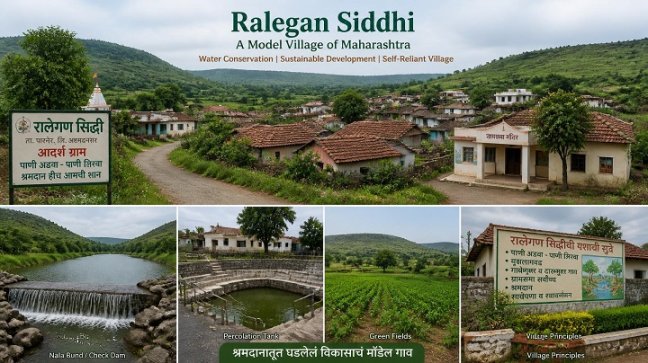
Table of Contents
Quick Facts About Ralegan Siddhi
- Also spelled as: Ralegan Shindhi / Ralegaon Siddhi
- Location: Parner taluka, Ahmednagar (Ahilyanagar) district, Maharashtra
- Distance from Pune: ~87 km
- Distance from Ahmednagar city: ~42 km
- Known for: Watershed management, renewable energy use, and participatory village governance
- Famous resident: Anna Hazare, social activist and village leader since 1975
- Governance model: Adarsh Gaon (Model Village), later replicated across Maharashtra
- Village type: Rural, governed by a Gram Panchayat
- Primary occupation: Agriculture, supported by irrigation from watershed structures
- Best known achievement: Transformation from a drought-prone, poverty-stricken village into a largely self-reliant model of sustainable development
Why Ralegan Siddhi Is Famous
Ralegan Siddhi’s reputation did not come from any single event but from a sustained, multi-decade transformation that touched nearly every part of village life:
- Rainwater harvesting and watershed development: Villagers built nalla bunds (check dams), contour trenches, and percolation tanks across the surrounding hills, allowing rainwater to soak into the ground instead of running off. This raised the water table dramatically and expanded irrigated land from roughly 70 acres to nearly 2,500 acres.
- Greening of barren hills: Extensive tree plantation drives stopped soil erosion on the hillsides that once contributed to the village’s chronic water scarcity.
- A pioneer in rural renewable energy: The village is frequently cited for its early and extensive use of solar power — individual solar panels for street lighting — along with biogas plants (some fed by community toilets) and a windmill for electricity generation.
- Social reforms driven by consensus, not law: Through the gram sabha (village assembly), residents collectively agreed to prohibit alcohol sale and consumption, dowry, open grazing of animals, and caste-based discrimination — enforcing these norms through social accountability rather than police action.
- Birthplace of the Adarsh Gaon Yojana: The Maharashtra government later modeled its official “Ideal Village Scheme” on Ralegan Siddhi’s watershed and self-governance practices, attempting to replicate the same results in other drought-affected villages.
- A live laboratory for direct democracy: Because most decisions are debated and decided in open gram sabha meetings, the village is frequently studied as an example of participatory local governance in action.
- Global and national recognition: Ralegan Siddhi’s model has been referenced in discussions on watershed development, sustainable agriculture, and rural self-governance well beyond Maharashtra, drawing visitors and researchers from India and abroad.
- Connection to a larger movement: Anna Hazare’s later national anti-corruption campaigns, including his high-profile involvement in the 2011 Lokpal Bill agitation, brought renewed attention to the village where his ideas on transparency and community accountability were first put into practice.
Population, Sex Ratio, and Literacy Rate
Based on Census 2011 figures, the most recent official village-level data available:
- Total population: 2,365
- Male population: 1,217
- Female population: 1,148
- Number of households: 530
- Sex ratio: 943 females per 1,000 males (higher than Maharashtra’s state average of 929)
- Children aged 0–6 years: 250 (139 male, 111 female)
- Scheduled Caste (SC) population: 229
- Scheduled Tribe (ST) population: 53
- Overall literacy rate: 76.53%
- Male literacy rate: 80.44%
- Female literacy rate: 72.39%
- Literate individuals: 1,810
- Illiterate individuals: 555
These figures reflect a striking turnaround. Historical records note that before Hazare’s education initiatives, male literacy in the village was as low as around 13% in 1971. Community-funded school construction, hostel facilities for underprivileged students, and a village-wide push for enrollment steadily raised these numbers over the following decades.
Administrative and Other Important Data
- State: Maharashtra
- District: Ahmednagar (officially renamed Ahilyanagar)
- Taluka/Tehsil: Parner
- Gram Panchayat: Ralegan Siddhi
- Governing body: Panchayati Raj system, led by an elected Sarpanch
- Total geographical area: Approximately 963–982 hectares
- PIN code: 414302
- STD/telephone code: 02488
- Vehicle registration code: MH-16
- Local/official language: Marathi
- Assembly (Vidhan Sabha) constituency: Parner
- Lok Sabha (Parliamentary) constituency: Ahmednagar
- Time zone: IST (UTC+5:30)
- Nearest railway station: Ranjangaon Road
- Nearest airport: Pune Airport (approx. 50 km aerial distance)
- Banking facilities: Bank and ATM available within the village
- Postal service: Post office available within the village
- Healthcare facilities: Health Sub-Centre, Primary Health Centre, and Community Health Centre all present within the village
- Public transport: Bus services available within the village
- Key crops grown in the region: Onion, jowar, and other rain-fed and irrigated crops
- Notable structures: Multiple nalla bunds, percolation tanks, biogas plants, and solar-powered street lighting
The Bigger Picture
What makes Ralegan Siddhi worth studying isn’t a single statistic — it’s the arc of the story. A village that once sent its young men elsewhere in search of work due to drought and scarcity now manages its own water, energy, and food security largely through community effort. The check dams still hold water on the hillsides, the solar lights still line its streets at night, and the gram sabha still meets to decide the village’s future collectively.
For students of rural development, policymakers exploring watershed-based solutions to water scarcity, or simply travelers looking for a meaningful detour along the Pune–Ahmednagar route, Ralegan Siddhi remains one of India’s most instructive examples of what grassroots leadership and sustained community will can accomplish — without waiting for outside intervention to arrive.
FAQs
1. Why is Ralegan Siddhi famous?
Ralegan Siddhi is famous for its remarkable transformation from a drought-hit, poverty-stricken village into a model of sustainable rural development, led by social activist Anna Hazare since 1975. It’s known for watershed management, rainwater harvesting, renewable energy use, and community-driven social reforms.
2. Who is credited with transforming Ralegan Siddhi?
Anna Hazare, a former Indian Army soldier, is credited with leading the village’s transformation after returning to his native village in 1975. He spearheaded watershed development, afforestation, and social reform initiatives through the village’s gram sabha.
3. What is the population of Ralegan Siddhi?
As per Census 2011, Ralegan Siddhi has a total population of 2,365, comprising 1,217 males and 1,148 females, spread across 530 households.
4. What is the literacy rate of Ralegan Siddhi?
The overall literacy rate of Ralegan Siddhi is 76.53%, with male literacy at 80.44% and female literacy at 72.39%, according to Census 2011 data.
5. How far is Ralegan Siddhi from Pune and Ahmednagar?
Ralegan Siddhi is located approximately 87 km from Pune and about 42 km from Ahmednagar (Ahilyanagar) city, within Parner taluka.
Want me to add these directly into the guest post file, or keep them as a standalone list?