

In the Makhdumpur block of Jehanabad district, barely a few kilometres from the pilgrim town of Bodh Gaya, a village Dharnai, that most of India had never heard of until a decade ago. Dharnai was, for thirty long years, a place electricity forgot. High-tension wires ran right past its rooftops on their way to bigger, better-connected towns, but not a single home inside the village ever saw a light bulb glow. Then, in July 2014, everything changed — and Dharnai became a name mentioned in energy policy circles from Patna to Paris.
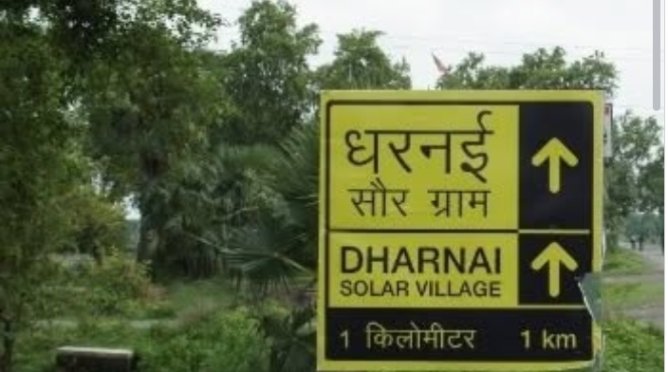
Table of Contents
Why Dharnai Became Famous
Dharnai’s rise to fame has nothing to do with forts, festivals, or freedom fighters — it’s about kilowatts. In 2014, Greenpeace India, along with two other organisations, installed a 100-kilowatt solar-powered micro-grid in the village, making Dharnai India’s first fully solar-powered village. Overnight, a settlement that had relied on kerosene lamps, firewood, and diesel generators for three decades found itself lit up around the clock.
The numbers behind the project were modest but mighty: the micro-grid, built at a cost of roughly Rs 3 crore, supplied uninterrupted power to about 450 households, over 50 shops and commercial establishments, 60 street lights, two schools, a health centre, and a skills-training facility. Villagers who had spent decades studying by lantern light or shutting their shops at dusk suddenly had access to fans, mobile charging points, irrigation pumps, and streetlights that stayed on after sunset. Bihar’s then Chief Minister, Nitish Kumar, personally visited the village and hailed the model as a glimpse of how rural India’s energy future could look.
Dharnai’s story didn’t stay uncomplicated, though. A little over a year after the launch, some villagers began demanding a connection to the regular state grid as well, citing limited power availability and higher costs of the solar system compared to conventional electricity. This turn of events sparked a genuinely important conversation in India’s renewable energy circles — about whether decentralised solar micro-grids can truly replace centralised power in ambition-hungry rural India, or whether they work best as a hybrid, stop-gap solution until the main grid arrives. Either way, Dharnai earned its place as a real-world case study, referenced in energy theses, NGO reports, and rural development case studies across the country.
Beyond the solar spotlight, Dharnai has the everyday markers of a well-connected Bihari village: it lies along a National Highway and has its own railway halt, a rarity for a settlement of its size, which is part of why it was originally chosen for the pilot project in the first place — the site had all the social infrastructure a growing village needed, minus the one thing that mattered most.
Dharnai at a Glance: Key Data (Census 2011)
- State / District / Block: Bihar → Jehanabad district → Makhdumpur block
- Nearest town: Makhdumpur (approx. 5 km away)
- District headquarters distance: Jehanabad town, approximately 20 km away
- Village code (Census 2011): 260479
- Local governance: Functions as its own Gram Panchayat, administered by an elected Sarpanch and Panchayat body
- Total geographical area: About 305 hectares
- Total population: 3,207 persons
- Male population: 1,651
- Female population: 1,556
- Total households: 541
- Sex ratio: 942 females per 1,000 males (above the Bihar state average of 918)
- Children (0–6 years): 534 — comprising 277 boys and 257 girls
- Overall literacy rate: Approximately 53.5%
- Male literacy rate: Around 63%
- Female literacy rate: Around 43%
- Total literates: 1,717 out of 3,207
- Scheduled Caste population: 756
- Scheduled Tribe population: 4
- Primary occupation: Agriculture, along with allied trade and small commercial establishments
- Connectivity: Located on a National Highway; served by a nearby railway halt
For context, Jehanabad district as a whole recorded a population of over 11 lakh, a sex ratio of 918, and a literacy rate of 78.27% as per the 2011 Census — meaning Dharnai’s literacy figures trail behind the wider district average, a common pattern for smaller, more remote villages within otherwise better-performing districts.
Life in Dharnai Today
Agriculture remains the backbone of Dharnai’s economy, much as it does across rural Jehanabad. Paddy, wheat, and pulses are commonly cultivated, and the solar micro-grid gave a genuine boost to small-scale irrigation and post-harvest activities that depend on reliable power. The village’s location — right along a highway with rail access — has also meant a steady, if modest, stream of small trade and commerce passing through, something that sets it apart from more isolated Bihari villages.
The social infrastructure that made Dharnai an attractive pilot site in 2014 continues to serve the community: it has schools, a healthcare facility, and a training centre, all of which benefited directly from the solar installation. Even amid the later grid-connection debate, the broader takeaway from Dharnai’s experience has held up — that decentralised renewable energy can dramatically improve quality of life in underserved rural pockets, even if it eventually needs to work alongside, rather than instead of, the central grid.
The Bigger Picture
Dharnai’s real significance lies less in its population count and more in what it represents. India has tens of thousands of villages still waiting for reliable power, and Bihar has historically ranked among the least electrified states in the country. Dharnai proved, in a very tangible way, that solar micro-grids could light up a village practically overnight — schools could hold evening classes, shopkeepers could stay open past sunset, and children could finally do their homework under something other than a kerosene flame.
Whether viewed as an energy success story, a case study in the limits of decentralised power, or simply a small Bihari village trying to catch up with the rest of the country, Dharnai’s journey from three decades of darkness to a moment of national attention remains one of rural India’s more compelling contemporary stories.
Frequently Asked Questions
1. Why is Dharnai village famous?
Dharnai is famous for becoming India’s first fully solar-powered village in July 2014, when Greenpeace India and two partner organisations installed a 100-kilowatt solar micro-grid that brought round-the-clock electricity to a village that had gone without power for over 30 years.
2. Where is Dharnai located?
Dharnai is located in the Makhdumpur block of Jehanabad district in Bihar, close to the pilgrim town of Bodh Gaya. It sits along a National Highway and has its own railway halt.
3. What is the population of Dharnai as per Census 2011?
Dharnai has a total population of 3,207, comprising 1,651 males and 1,556 females, spread across 541 households.
4. What are the sex ratio and literacy rate of Dharnai?
The village has a sex ratio of 942 females per 1,000 males, which is higher than the Bihar state average of 918. Its overall literacy rate stands at around 53.5%, with male literacy near 63% and female literacy near 43%.
5. Is Dharnai still fully dependent on solar power today?
Not entirely. About a year after the solar micro-grid was launched, many residents also sought a connection to the regular state electricity grid, citing limited power capacity and higher costs compared to conventional supply. Today, the village is often cited as a case study on how decentralised solar systems can work alongside, rather than fully replace, the central grid in rural India.