

Kokrebellur (also spelled Kokkare Bellur) is a small village in Karnataka’s Mandya district where thousands of spot-billed pelicans and painted storks nest directly on trees inside people’s backyards, and where villagers have protected this bond for generations instead of driving the birds away.
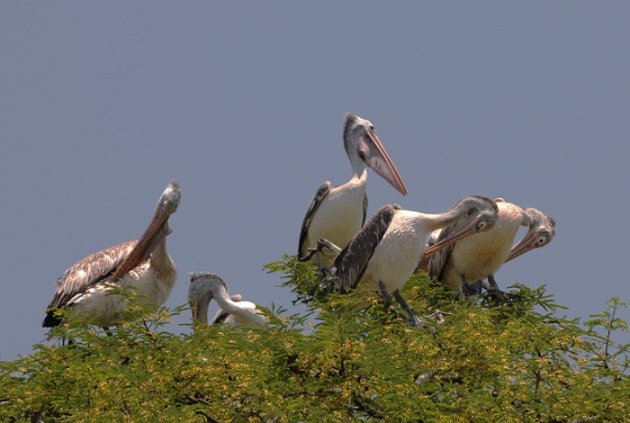
Table of Contents
About Kokrebellur
Tucked into Maddur taluk, roughly 80–90 km southwest of Bengaluru on the Bengaluru–Mysuru highway, Kokrebellur is often described as a “two-tier village” — humans occupy the ground floor, while pelicans and storks nest in the tamarind, banyan, and fig tree canopies just above. The name itself comes from Kannada: “kokkare” means stork or pelican, and “bellur” means village, so Kokrebellur essentially translates to “Village of Storks.”
Every year, from around November-December through June, spot-billed pelicans arrive first and settle on the crowns of the tallest, oldest trees. A few weeks later, painted storks follow and take up the outer branches of the same trees, so that nests from both species end up almost touching each other. For roughly six months, birds and humans share the same physical space, going about their lives just a few metres apart, before the birds migrate away again as summer peaks. This cycle has repeated for generations, and locals say the birds return to the exact same trees, year after year.
In 2017, Kokrebellur was formally declared a Community Reserve under the Wildlife Protection Act, 1972 — a distinction that makes it the only community reserve of its kind in Karnataka, and a rare instance where conservation status was granted to protect a human settlement’s relationship with wildlife, rather than a purely natural habitat.
The Story Behind the Bond
The connection between the villagers and the birds isn’t a modern conservation project — it predates any formal protection by decades. Historical mentions of pelicans in this area go back to naturalist T.C. Jerdon’s writings in 1853. For generations, villagers collected the birds’ droppings, or guano, which is rich in phosphorus and potassium, and used it as free, natural fertiliser for their fields. In exchange, they protected the nesting trees, avoided cutting them down even when it meant losing tamarind harvests or usable farmland beneath the canopy, and stepped in to rescue chicks that fell from nests.
The relationship was formalised in 1976, when forest officer S.G. Neginhal introduced a compensation scheme to pay villagers for crop and land losses caused by nesting colonies — recognising that conservation shouldn’t come at the sole financial cost of the local community. That principle still guides efforts today. The Karnataka Forest Department, the Mandya Zilla Panchayat, and the Karnataka State Tourism Development Corporation (KSTDC) now work alongside the Village Forest Committee and the NGO Hejjarle Balaga (meaning “relatives of the pelican,” run under Mysore Amateur Naturalists) to protect nesting trees, rescue injured hatchlings, maintain the surrounding water tanks that supply fish for the birds, and slowly build eco-tourism as an additional source of income for residents.
Beyond pelicans and painted storks, the village hosts several other nesting and visiting species, including little cormorants, black ibis, grey herons, black-crowned night herons, and Indian pond herons — with close to 250 bird species recorded in the wider area over the years.
Why It’s Worth Visiting
Kokrebellur offers something genuinely rare: the chance to observe large water birds nesting at close range, without binoculars, watchtowers, or a long forest trek. A short walk through the village lanes puts you directly beneath trees packed with pelican and stork nests, chicks calling out for food, and adults arriving with fish. A few reasons travellers add it to their itinerary:
- Close-up views of spot-billed pelicans and painted storks nesting above homes and streets
- A rare working example of community-led wildlife conservation, rather than a fenced sanctuary
- Sightings of supporting species such as cormorants, ibis, and herons around the village tanks
- Peaceful rural scenery, with paddy fields, sugarcane farms, and the Shimsha River nearby
- An easy day trip from both Bengaluru and Mysuru, since it sits just off the highway connecting the two cities
- Opportunities to interact with villagers and local guides who have grown up alongside the birds
The best time to visit is between December and March, when nesting activity is at its peak and chicks are visible in large numbers.
Getting There
Kokrebellur lies about 12 km off the Bengaluru–Mysuru highway, near a turn-off close to Maddur town, roughly 20 km northeast of Mandya city. The nearest railway stations are at Maddur and Mandya, both on the Bengaluru–Mysuru broad-gauge line. The nearest airport is Kempegowda International Airport in Bengaluru, which has regular domestic and international connections. Regular buses run from Bengaluru to Maddur, from where local transport or a short taxi ride covers the remaining distance to the village.
Quick Facts: Kokrebellur
- State: Karnataka
- District: Mandya
- Taluk: Maddur
- Type: Village and Community Reserve (declared in 2017 under the Wildlife Protection Act, 1972)
- Location: About 800 m west of the Shimsha River, roughly 12 km off the Bengaluru–Mysuru highway near Maddur
- Distance from Bengaluru: Approximately 80–90 km
- Distance from Mysuru: Approximately 40–50 km
- Distance from Mandya city: Roughly 20 km
- Nearest railway stations: Maddur and Mandya (Bengaluru–Mysuru line)
- Nearest airport: Kempegowda International Airport, Bengaluru
- Population: Estimated at roughly 1,500–3,000 residents; figures vary by source since it is a small hamlet without a separately published large-village census entry
- Local language: Kannada
- Key bird species: Spot-billed pelican and painted stork (both classified “Near Threatened” on the IUCN Red List), plus little cormorants, black ibis, grey herons, black-crowned night herons, and Indian pond herons
- Peak nesting season: December to March
- Main local economy: Agriculture (sugarcane and paddy cultivation), supplemented by growing bird-watching tourism
- Administrative oversight: Mandya Zilla Panchayat, supported by the Karnataka Forest Department, KSTDC, the Village Forest Committee, and the NGO Hejjarle Balaga
Note on census data: Kokrebellur is a small hamlet, and the Census of India does not publish a separate, detailed breakdown of sex ratio and literacy rate exclusively for it. For broader context, Maddur taluk (in which the village falls) recorded a sex ratio of approximately 998 females per 1,000 males and a literacy rate of around 62% as per Census 2011, while Mandya district overall recorded a sex ratio of 995 and a literacy rate of 70.4%. These figures reflect the taluk and district, not the village in isolation.
In Short
Kokrebellur isn’t a wildlife sanctuary in the conventional sense — there are no fences, entry gates, or forest buffers separating people from birds. It is a living, working village where an age-old understanding between farmers and migratory birds has quietly survived decades of change, making it one of Karnataka’s most compelling examples of grassroots conservation and a worthwhile stop for anyone travelling between Bengaluru and Mysuru.
Frequently Asked Questions (FAQs)
1. What is Kokrebellur famous for?
Kokrebellur is famous for being a village where spot-billed pelicans and painted storks nest directly on trees within the village itself, alongside human homes, rather than in a separate forest or sanctuary. This unusual coexistence has earned it recognition as a model of community-based bird conservation.
2. When is the best time to visit Kokrebellur to see the birds?
The best time to visit is between December and March, when nesting activity peaks and both pelicans and painted storks are present in large numbers, along with their chicks.
3. How far is Kokrebellur from Bengaluru and Mysuru?
Kokrebellur is approximately 80–90 km from Bengaluru and around 40–50 km from Mysuru, making it accessible as a day trip from either city via the Bengaluru–Mysuru highway.
4. Is Kokrebellur a wildlife sanctuary?
Not in the traditional sense. It was declared a Community Reserve in 2017 under the Wildlife Protection Act, 1972, but it remains an inhabited village without fencing or forest cover separating the birds from residents.
5. Is there an entry fee or fixed visiting time for Kokrebellur?
Kokrebellur is a functioning village rather than a managed tourist park, so there is generally no formal ticketed entry system like at a wildlife sanctuary; however, visitors are encouraged to be respectful of residents’ privacy and property, and it’s best to check locally or with a guide for any current guidelines, parking, or guide fees before visiting.