

Neraluru is a village in Anekal taluk, Bangalore Urban district, Karnataka, that has managed to hold onto its rural, temple-centered identity even as it becomes an increasingly active corridor of residential and industrial growth on the southeastern edge of Bangalore.
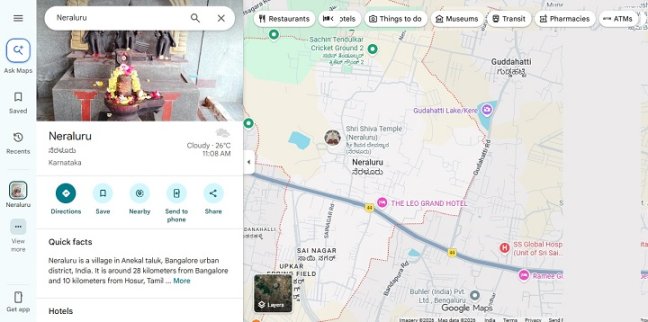
Table of Contents
Quick Facts: Neraluru Village
Location & Administration
- State: Karnataka
- District: Bangalore Urban
- Taluk: Anekal
- Hobli: Attibele
- Pincode: 562107
- Distance from Bangalore city: ~28 km
- Distance from Hosur (Tamil Nadu): ~10 km
- Nearby towns: Attibele, Chandapura (both within ~5 km)
- Primary language: Kannada
Population (2011 Census)
- Total population: 5,608
- Households/families: 1,500
- Male population: 3,217
- Female population: 2,391
- Sex ratio: 743 females per 1,000 males (below Karnataka’s average of 973)
- Child (0–6 yrs) population: 694, about 12.38% of total
- Child sex ratio: 1,135 (above Karnataka’s average of 948)
Literacy Rate (2011 Census)
- Overall literacy: 87.34% (higher than Karnataka’s state average of 75.36%)
- Male literacy: 91.87%
- Female literacy: 80.86%
Governance
- Local body: Neraluru Grama Panchayat — among the largest in Karnataka
- Elected representatives: 64 (as of 2021)
- Representatives from Neraluru village: 14
- Villages under the panchayat: 9 — Neraluru, Thirumagondanahalli, Balagaranahalli, Icchanguru, Vaddarapalya, Yadavanahalli, Adigondanahalli, Guddahatti, Bendaganahalli
- Constituency: Anekal (Vidhan Sabha); Bangalore Rural (Lok Sabha)
Culture & Landmarks
- Key temples: Shiva, Anjaneya, and Yellamma Devi temples
- Annual festival: Rathotsava (chariot festival), held in March/April
- Notable nearby commercial site: Hotel Ramee Guestline (4-star)
- Residential townships nearby: Shivapriya, Upkar Springfields
Economy & Growth
- Industrial presence: Part of the Attibele industrial area
- Real estate trend: Rising interest due to proximity to Sarjapur Road; ~65% price appreciation over 5 years
- Growth drivers: Affordable land, industrial jobs, Bangalore’s outward urban expansion
A Village Rooted in Anekal’s History
To understand Neraluru, it helps to understand Anekal taluk itself. Anekal, the southernmost taluk of Bangalore district, has a history stretching back to the 17th century, when a fort was built here by Chikka Thimme Gowda after he acquired the territory from a general of Bijapur. The region later passed into Mysore’s control under Hyder Ali, and traces of its Hoysala-era past still survive in nearby villages through old temples and inscriptions. Neraluru sits within this historically layered landscape, roughly 28 kilometers from central Bangalore and about 10 kilometers from Hosur across the Tamil Nadu border, with the towns of Attibele and Chandapura both within a 5-kilometer radius.
Like much of Anekal taluk, Neraluru’s identity has long been tied to agriculture and faith. The village is home to several temples that have been renovated in recent years, the most prominent dedicated to Shiva, Anjaneya, and Yellamma Devi. Each year, typically in March or April, the village holds an annual rathotsava (chariot festival), during which a seven-tiered wooden chariot is pulled through Neraluru’s streets by devotees — a tradition that draws residents and visitors from surrounding villages and remains one of the most vivid expressions of local culture.
From Farmland to Growth Corridor
Neraluru’s story today is really the story of Bangalore outgrowing its old boundaries. As the city’s real estate market pushed outward in search of affordable land, villages like Neraluru — close enough to Bangalore for a commute, yet still relatively inexpensive — became natural targets for development. The Attibele industrial area now extends into part of the Neraluru landscape, and this industrial presence has drawn a steady stream of migrant workers who have settled in and around the village, changing its social fabric in the process.
Residential development has followed close behind. Townships such as Shivapriya and Upkar Springfields have come up in Neraluru’s vicinity, catering to buyers looking for value outside Bangalore’s congested core. A four-star property, Hotel Ramee Guestline, sits about a kilometer away, a small but telling sign of the commercial activity now surrounding what was once purely farmland. Property listings for the area describe average rates in the range of roughly ₹1,800 to ₹7,500 per square foot, with the last five years showing appreciation of over 60 percent — a reflection of investor interest in the broader Sarjapur Road growth belt, even as public transport and last-mile connectivity remain works in progress.
Despite this change, Neraluru has not lost its semi-rural character. Fields still border residential plots in places, and the pace of life away from the main roads remains noticeably slower than in Bangalore proper.
Governance: Karnataka’s Largest Gram Panchayat
If there is one fact that makes Neraluru genuinely distinctive, it’s administrative. The Neraluru Grama Panchayat is considered one of the largest in the entire state of Karnataka, made up of 64 elected representatives as of 2021 — an unusually large body for a village-level panchayat. Neraluru village itself sends 14 members to this panchayat, and the panchayat’s jurisdiction extends well beyond Neraluru to cover nine villages in total: Neraluru, Thirumagondanahalli, Balagaranahalli, Icchanguru, Vaddarapalya, Yadavanahalli, Adigondanahalli, Guddahatti, and Bendaganahalli.
This scale gives Neraluru an outsized administrative role relative to its population, and it means decisions made in the village ripple outward to a cluster of surrounding communities. For residents, it also means a relatively dense network of local representation compared to smaller single-village panchayats elsewhere in the state.
Education and Everyday Life
As Neraluru and the wider Anekal taluk have grown, so has the local education infrastructure. Anekal town, the taluk headquarters not far from Neraluru, now hosts institutions ranging from government lower and higher primary schools to private and faith-run institutions such as St. Joseph’s PU College and National Public School, Anekal — options that serve families across the taluk, including those living in and around Neraluru. Government primary and upper-primary schools are also spread through the taluk’s rural clusters, reflecting the area’s continuing mix of village and township life.
How to Reach Neraluru
Neraluru is well connected to Bangalore and its neighboring towns, mainly through road transport, though it still lacks a dedicated railway station or direct metro access of its own.
- By Road: Neraluru lies just off Hosur Road (NH44), close to Attibele and Chandapura, making it an easy drive from central Bangalore in roughly an hour depending on traffic. BMTC city buses — including routes in the 356, 357, 358, 359, 360, and 410 series, along with services like 328H and 328HB connecting Attibele to Hoskote and K.R. Puram — stop at Neraluru Cross, the main bus halt for the village, which is within a short walk of the village center. These buses link Neraluru to major Bangalore hubs such as K.R. Puram, Shivajinagar, Majestic, and Electronic City.
- By Rail: Neraluru does not have its own railway station. The nearest railheads are along the Bangalore–Chennai and Bangalore–Hosur lines, with Bangalore City Junction and Bangalore Cantonment serving as the main long-distance stations; from there, road transport covers the remaining distance to the village.
- By Air: The nearest airport is Kempegowda International Airport, Bangalore, which is well outside the city and typically requires a drive of an hour and a half to two hours from Neraluru via the outer ring road network, depending on the route taken and traffic conditions.
- Local Landmarks for Navigation: Neraluru Cross, Thirumagondanahalli, and Guddahatti Cross are commonly used reference points when giving directions to the village, and the Attibele Industrial Area serves as a well-known nearby landmark for both taxis and delivery services.
Conclusion
Neraluru captures, in miniature, what is happening across the villages ringing Bangalore: centuries-old temple traditions and a slow-paced agrarian rhythm now sit alongside industrial units, new townships, and rising land values. It is not a tourist destination in the conventional sense, but it is a place where Karnataka’s rural governance system, culture, and urban growth intersect in an unusually concentrated way — most visibly through its outsized Grama Panchayat, which oversees nine villages and stands among the largest in the state. As Bangalore’s boundaries keep pushing outward, Neraluru is likely to keep evolving, balancing its rural character against the steady pull of the city next door.
Frequently Asked Questions (FAQs)
1. Where is Neraluru village located?
Neraluru is located in Anekal taluk, Bangalore Urban district, Karnataka, about 28 km from central Bangalore and 10 km from Hosur, Tamil Nadu.
2. What is Neraluru famous for?
Neraluru is best known for its Grama Panchayat, which is among the largest in Karnataka, overseeing nine villages. It is also known locally for its Shiva, Anjaneya, and Yellamma Devi temples and its annual rathotsava (chariot festival).
3. What is the population of Neraluru?
As per the 2011 Census, Neraluru had a population of 5,608 people across 1,500 households, with a literacy rate of 87.34%.
4. How can I reach Neraluru from Bangalore?
Neraluru is accessible by road via Hosur Road (NH44), with several BMTC bus routes stopping at Neraluru Cross. It has no railway station of its own; the nearest major stations are in central Bangalore.
5. Is Neraluru a good place for real estate investment?
The area has seen rising real estate interest due to its proximity to Sarjapur Road and Bangalore’s outward expansion, with reported price appreciation of around 65% over five years. As with any investment, it’s worth independently verifying current prices, connectivity plans, and legal land status before purchasing.