


There are few household annoyances quite as persistent as a clogged drain. One moment water disappears with a satisfying gurgle; the next it pools around your ankles in the shower or refuses to leave the kitchen sink entirely. Most people reach for the phone to call a plumber. But the truth is, the majority of household clogs — hair, soap scum, grease, food particles — are entirely DIY-solvable. You need patience, a little know-how, and the right method for the right clog.
This guide walks you through every approach, from the gentlest to the most aggressive, so you can clear your drain without wasting money or damaging your pipes.
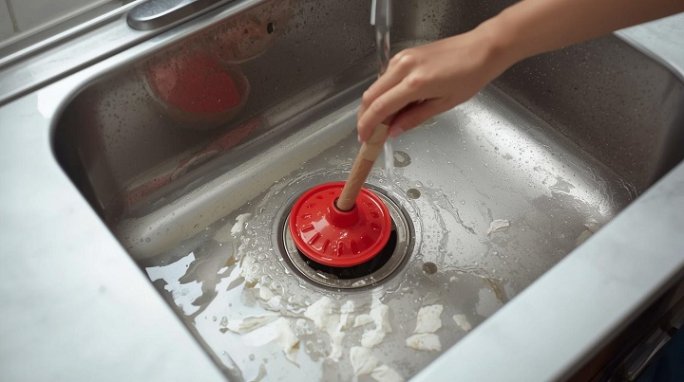
Table of Contents
Before You Begin: Know What You’re Dealing With
The type of drain — and what’s blocking it — determines your best strategy. A bathroom sink clogged with hair responds differently than a kitchen drain lined with months of cooking grease. Ask yourself: is the blockage in a single drain, or are multiple drains in the house slow? If multiple drains are affected, the clog may be in the main sewer line, which genuinely does require professional intervention. For everything else, read on.
Single slow drain = local clog, DIY-friendly. Multiple drains backing up simultaneously = main line issue, call a plumber.
Method 1 — Boiling Water
The simplest method, and often the most underestimated. Ideal for kitchen sinks where grease has solidified inside the pipe.
- Boil a full kettle of water.
- Pour it slowly down the drain in two or three stages, allowing 5–10 seconds between each pour.
- The heat melts grease and soap buildup clinging to pipe walls.
- Follow with cold water once clear.
Do not use boiling water on PVC or plastic pipes — high heat can soften or warp them. Use very hot tap water instead.
Method 2 — Baking Soda & Vinegar
The classic chemistry-class reaction turns into an effective drain cleaner. This works well on soft organic clogs in bathroom and kitchen drains.
- Pour ½ cup of baking soda directly down the drain.
- Follow immediately with ½ cup of white vinegar.
- Cover the drain opening with a cloth or stopper — this forces the fizzing reaction downward into the clog rather than back up.
- Wait 20–30 minutes, then flush with hot water.
- Repeat once if needed.
“Most household clogs yield to hot water and baking soda before a plumber’s snake ever becomes necessary.”
Method 3 — The Plunger
Criminally underused for sink drains. People associate plungers with toilets, but a cup plunger is one of the most effective tools for kitchen and bathroom sinks.
- If your sink has an overflow hole (the small hole near the rim), block it with a wet cloth — this creates the necessary suction.
- Add enough water to cover the cup of the plunger.
- Position the plunger cup directly over the drain and press down firmly to form a seal.
- Plunge vigorously 10–15 times, then pull up sharply to break the seal.
- Repeat 3–4 times; flush with hot water.
Method 4 — Drain Snake (Hand Auger)
When gentler methods fail — often the case with hair clogs deep in a bathroom pipe — a drain snake is your next step. You can pick one up at any hardware store for under ₹600–₹800.
- Feed the flexible cable into the drain opening, rotating the handle clockwise as you push.
- When you feel resistance, you’ve hit the clog — continue turning to break it up or hook it.
- Slowly retract the snake, pulling out whatever material has been caught.
- Flush thoroughly with hot water.
- Repeat if drainage is still slow.
Method 5 — Clean the P-Trap
The P-trap is the curved pipe section directly beneath your sink. It’s designed to hold water (which prevents sewer gases from entering your home), but it’s also a prime location for clogs to gather.
- Place a bucket under the curved pipe to catch water.
- Unscrew the slip-joint nuts at either end of the P-trap by hand (or with pliers if needed).
- Remove the trap and empty its contents into the bucket.
- Clean the interior with a brush and rinse thoroughly.
- Reassemble and run water to check for leaks.
Wear rubber gloves — P-traps collect some of the most unpleasant material in your plumbing system. The job takes 10 minutes and often resolves persistent clogs immediately.
Shower & Bathtub Drains: The Hair Problem
Shower drains are almost always clogged with hair — sometimes years’ worth of it. Your first move here should be mechanical, not chemical.
Remove the drain cover (usually just a few screws). Use a pair of needle-nose pliers, a drain claw, or even a bent wire coat hanger to reach in and pull out the hair blockage. It’s unpleasant, but deeply satisfying. Once clear, follow up with the baking soda and vinegar method to flush out residual soap scum.
What About Chemical Drain Cleaners?
Products like caustic soda or commercial drain unblockers can dissolve organic matter effectively — but they come with significant caveats. Repeated use corrodes metal pipes and degrades rubber gaskets over time. They are also hazardous to handle and harmful to the environment. Use them sparingly, as a last resort before calling a plumber, and never on a completely standing-water situation where the chemical has nowhere to go.
Prevention: The Real Long Game
The easiest clog to deal with is the one that never forms. A few habits make a significant difference. Fit mesh drain strainers in every shower and sink — they catch hair and food debris before it enters the pipe. Pour a kettle of hot water down your kitchen drain once a week to keep grease from building up. Never put cooking oil, coffee grounds, or starchy foods like pasta and rice down the sink.
Once a month, run the baking soda and vinegar treatment as maintenance rather than crisis response. These small rituals add up to drains that simply stay clear.
“A mesh strainer and a monthly baking soda flush are worth more than any bottle of drain cleaner.”
When to Call a Professional
Know when to hand it over. If you’ve worked through every method here and water still drains slowly — or if multiple fixtures in your home are affected simultaneously — you’re likely dealing with a blockage in the main sewer line or a more complex plumbing issue. Similarly, if you notice foul smells persisting after clearing, or hear gurgling in other drains when you flush, these are signs of a deeper problem that warrants a licensed plumber.
There is no shame in knowing your limits. The methods in this guide handle the vast majority of household clogs. When they don’t, you’ll have done the necessary triage to give a professional a clear picture of what they’re dealing with.