

India’s air conditioner market has grown at a blistering pace over the last decade, driven by rising temperatures, growing disposable incomes, and increasing urbanization. What was once a luxury appliance reserved for the affluent is now a near-essential item in most middle-class Indian households. With this surge in demand, dozens of brands — Indian and international — are competing for a share of the market, each bringing its own technology, pricing strategy, and after-sales approach to the table.
If you’re planning to buy a new air conditioner, understanding which companies dominate the Indian market — and where each one excels or falls short — can save you both money and future headaches. Here’s a detailed look at the top AC companies in India.
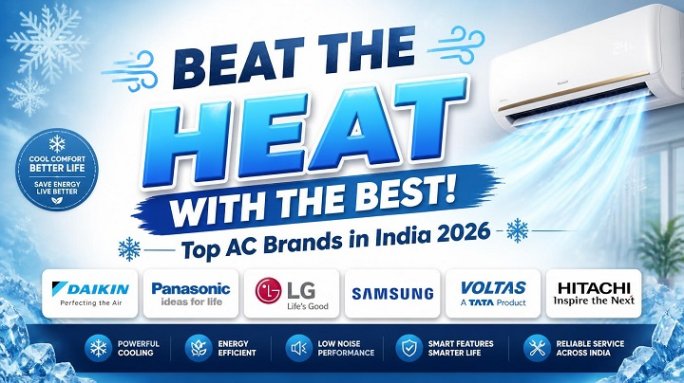
Table of Contents
1. Voltas
Voltas, a Tata Group company, has consistently held the number one position in India’s room AC market for several years. It built its reputation on affordability combined with reasonably good performance, making it a favorite among budget-conscious buyers.
Strengths:
- Strong brand trust owing to its Tata Group association.
- Extensive service network across urban and rural India, including tier 2 and tier 3 cities.
- Competitive pricing across a wide range of models.
- Good cooling performance even in India’s harsher summer conditions.
Weaknesses:
- Build quality and finish can feel less premium compared to Japanese or Korean brands.
- Smart features and app connectivity lag behind competitors like LG and Samsung.
- Some users report noise levels being slightly higher than premium alternatives.
2. LG Electronics
LG has carved out a strong position in the Indian AC market by combining aggressive marketing with genuinely innovative technology, particularly its Dual Inverter compressor technology.
Strengths:
- Industry-leading inverter technology that offers excellent energy efficiency.
- Strong smart home integration through the LG ThinQ app.
- Sleek, modern designs that appeal to urban consumers.
- Reliable customer service network in most major cities.
Weaknesses:
- Higher price point compared to Indian brands like Voltas or Lloyd.
- Service response times can be slower in smaller towns.
- Spare parts can be relatively expensive.
3. Daikin
Daikin, a Japanese multinational, is often regarded as a specialist brand purely because air conditioning is its core business, unlike many competitors who sell ACs as part of a broader appliance portfolio.
Strengths:
- Exceptional build quality and long-term durability.
- Advanced inverter and cooling technology backed by decades of R&D focus purely on HVAC systems.
- Strong performance in extreme heat conditions, which suits much of India’s climate.
- Good warranty support on compressors.
Weaknesses:
- Premium pricing makes it less accessible for budget buyers.
- Fewer aggressive discounts or offers compared to mass-market brands.
- Limited focus on smart/IoT features compared to Samsung or LG.
4. Blue Star
Blue Star is another homegrown Indian brand with a long legacy in cooling solutions, spanning both residential and commercial air conditioning.
Strengths:
- Decades of experience in commercial and industrial cooling, which translates into robust residential products.
- Strong performance in high-temperature and high-humidity regions.
- Good balance between price and performance.
- Reliable service network built over years of commercial project execution.
Weaknesses:
- Design aesthetics are considered more functional than stylish.
- Smart features are relatively basic compared to global brands.
- Fewer models in the ultra-premium segment.
5. Samsung
Samsung brings its consumer electronics expertise into the AC segment, focusing heavily on smart features and sleek design.
Strengths:
- Excellent smart connectivity through SmartThings app integration.
- Stylish, minimalist designs that fit well with modern interiors.
- Strong digital inverter technology for energy savings.
- Good brand recall and trust due to Samsung’s overall consumer electronics dominance.
Weaknesses:
- Pricing tends to be on the higher side.
- After-sales service, while decent, is sometimes reported as inconsistent across regions.
- AC is not Samsung’s core focus area in India compared to phones and TVs, which occasionally shows in product refresh cycles.
6. Hitachi
Hitachi has built a niche reputation in India as a premium, performance-focused AC brand, particularly popular among consumers who prioritize durability over flashy features.
Strengths:
- Known for extremely durable compressors and long product life.
- Strong cooling efficiency, especially suited to Indian summer conditions.
- Good reputation for after-sales support among long-term users.
Weaknesses:
- Pricing is on the higher end of the spectrum.
- Design language feels dated compared to Samsung or LG.
- Fewer smart home features relative to competitors.
7. Carrier (Carrier Midea India)
Carrier, in partnership with Midea, has been steadily expanding its footprint in India, leveraging its global HVAC expertise.
Strengths:
- Strong global R&D background in cooling technology.
- Competitive pricing in the mid-range segment.
- Decent energy efficiency ratings across its product range.
Weaknesses:
- Brand recall in India is weaker compared to legacy players like Voltas or LG.
- Service network, while growing, is not as widespread as more established brands.
- Limited presence in the ultra-premium segment.
8. Panasonic
Panasonic has maintained a steady, if less aggressive, presence in the Indian AC market, focusing on reliability and air purification features.
Strengths:
- Strong focus on air quality features like nanoe-X air purification technology.
- Reliable performance and decent build quality.
- Good energy efficiency across inverter models.
Weaknesses:
- Marketing presence is weaker compared to Samsung, LG, or Daikin.
- Fewer aggressive pricing strategies, making it less attractive to budget buyers.
- Slower innovation cycle compared to Korean competitors.
9. Godrej
Godrej, one of India’s oldest conglomerates, has been pushing its AC business with an emphasis on eco-friendly refrigerants and sustainability.
Strengths:
- Early adopter of eco-friendly refrigerants like R290, appealing to environmentally conscious buyers.
- Strong brand trust due to Godrej’s legacy in Indian households.
- Competitive pricing in the mass-market segment.
Weaknesses:
- Limited presence in the premium and luxury AC segments.
- Fewer smart features compared to global competitors.
- Service network, while decent, isn’t as extensive as Voltas or LG.
10. Lloyd
Lloyd, now owned by Havells, has rapidly gained market share by focusing on affordability without completely compromising on features.
Strengths:
- Aggressive pricing that appeals strongly to first-time AC buyers.
- Backed by Havells’ distribution and service network.
- Decent energy efficiency ratings for the price point.
Weaknesses:
- Build quality is perceived as average compared to premium brands.
- Long-term durability data is still being established since it’s a relatively newer major player.
- Fewer high-end or smart AC models.
How to Choose the Right AC Brand for Your Needs
With so many strong contenders, choosing the right brand ultimately comes down to your specific priorities:
- If budget is your primary concern, Voltas, Lloyd, or Godrej offer a strong balance of affordability and decent performance.
- If you want cutting-edge smart features, LG and Samsung lead the pack with their app-based controls and connected home ecosystems.
- If durability and long-term reliability matter most, Daikin and Hitachi are worth the higher upfront investment.
- If you live in an extremely hot or humid region, Blue Star and Daikin’s specialization in cooling technology gives them an edge.
- If sustainability is a priority, Godrej’s eco-friendly refrigerant options stand out.
Final Thoughts
The Indian AC market is no longer a one-size-fits-all landscape. Each brand has carved out a distinct positioning — whether through pricing, technology, durability, or design — to appeal to different segments of consumers. Rather than chasing the single “best” brand, it’s more useful to match a brand’s particular strengths against your own priorities, whether that’s your budget, your climate, or your appetite for smart home integration.
Before making a final decision, it’s also worth checking energy efficiency star ratings (as per Bureau of Energy Efficiency, BEE, standards), warranty terms on compressors, and the density of authorized service centers in your specific city. A slightly more expensive AC with better local service support can often turn out to be a smarter long-term investment than the cheapest option on the shelf.